Division 7A Loans: What Business Owners Need to Know in 2026–27


Updated September 2026
Taking money from your company is not always as simple as transferring cash to your personal account.
If a private company lends money, makes certain payments or forgives a debt involving a shareholder or their associate, Division 7A may apply.
Division 7A forms part of the Income Tax Assessment Act 1936. It is designed to prevent private companies from making tax-free distributions of profits to shareholders or their associates through loans, payments or debt forgiveness.
For business owners, the important point is simple: Division 7A loans need to be identified early and managed correctly. If a loan is not repaid or put on complying terms within the required timeframe, it may result in an unfranked dividend being included in the recipient’s assessable income.
This guide explains when Division 7A applies, how complying loans work, the current benchmark interest rate, minimum yearly repayments and what business owners should review each year.
Division 7A loans at a glance
- Division 7A can apply when a private company provides money or certain other financial benefits to a shareholder or their associate.
- A loan that is not fully repaid by the company’s lodgment day may need to be placed under a complying loan agreement.
- A complying loan agreement must be in writing and meet Division 7A requirements for interest, loan term and repayments.
- The Division 7A benchmark interest rate for 2026–27 is 8.77%.
- Unsecured loans generally have a maximum term of seven years.
- Certain loans secured by real property can have a maximum term of 25 years.
- Minimum yearly repayments are generally required after the income year in which the loan is made.
- Missing a required repayment can result in a shortfall being treated as an unfranked dividend.
What is Division 7A?
Division 7A is a tax provision dealing with certain benefits provided by a private company to shareholders or their associates.
The rules exist because company money and personal money are separate. A private company cannot simply distribute profits to shareholders tax free by describing the payment as a loan, advance or another form of financial accommodation.
Division 7A can potentially apply where a private company:
- lends or advances money
- provides credit or other financial accommodation
- pays expenses for a shareholder or their associate
- makes certain payments through another entity
- forgives a debt owed by a shareholder or their associate.
Although the term director loan is commonly used, being a director alone does not trigger Division 7A. The rules principally apply to shareholders and their associates.
What is a Division 7A loan?
A Division 7A loan can arise where a private company lends money or provides financial accommodation to a shareholder or their associate.
It does not have to look like a formal bank loan.
For example, a business owner may:
- transfer company funds into their personal account
- use the company account to pay personal expenses
- allow a shareholder loan account to build up throughout the year.
When the accounts are prepared, these transactions may appear as money owed back to the company.
Having a loan is not necessarily the problem. The issue is whether the loan has been repaid or properly structured within the Division 7A rules.
Can I borrow money from my company?
Potentially, yes.
If the loan is not fully repaid before the company’s lodgment day for the relevant income year, it will generally need to meet the requirements for a complying Division 7A loan to avoid being treated as a deemed dividend.
That means having an appropriate written agreement in place and meeting the Division 7A rules for:
- the benchmark interest rate
- maximum loan term
- minimum yearly repayments.
It is also worth asking whether borrowing from the company is the best option.
Depending on your circumstances, salary, director’s fees, a properly declared dividend or personal finance may provide a better outcome.
Before borrowing from your company, it is also worth considering the broader financial and cash flow implications. Read more about the [risks of borrowing money from your business].
What is a complying Division 7A loan?
A complying loan is a private company loan that meets the relevant Division 7A requirements.
The loan agreement must be in writing before the company’s lodgment day for the income year in which the loan was made.
The agreement should clearly document the parties, loan amount, obligation to repay, interest and loan term.
Requirement
Division 7A rule
Written agreement
Must be in place before the company’s lodgment day
Interest rate
Must meet or exceed the applicable benchmark interest rate
Unsecured loans
Maximum term of seven years
Qualifying secured loans
Maximum term of 25 years
Repayments
Minimum yearly repayments generally required after the year the loan is made
Simply recording an amount as a director loan in the company accounts does not automatically make it a complying loan agreement.
When does the loan agreement need to be in place?
For Division 7A purposes, the company’s lodgment day is the earlier of:
- the due date for lodging the company’s tax return, or
- the date the company actually lodges its tax return.
A relevant loan can generally be repaid or placed under a complying loan agreement before that date.
For example, if a private company lends money to a shareholder during the 2026–27 financial year, the loan should be identified and dealt with before the company’s 2026–27 tax return is lodged or becomes due.
This is why shareholder and director loan balances should be reviewed before the company tax return is finalised.
What is the Division 7A interest rate for 2026–27?
The Division 7A benchmark interest rate for the 2026–27 income year is 8.77%.
The benchmark interest rate is updated annually and affects both the interest payable and the calculation of minimum yearly repayments.
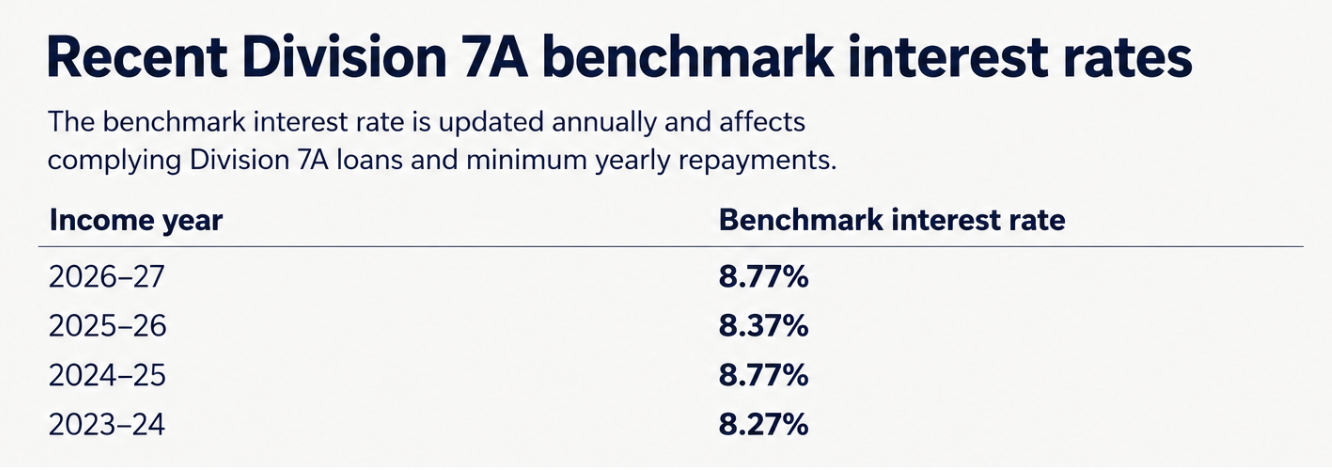
Because the interest rate can change from year to year, business owners should not assume last year’s minimum repayment will still be sufficient.
How long can a Division 7A loan run for?
Unsecured Division 7A loans
For unsecured loans, the maximum loan term is generally seven years.
Secured Division 7A loans
Certain secured loans can have a maximum term of 25 years.
To qualify for the longer term:
- the entire loan must be secured by a registered mortgage over real property
- when the loan is first made, the property’s market value, less any liabilities secured over it in priority to the Division 7A loan, must be at least 110% of the loan amount.
For example: A shareholder borrows $100,000 from their private company. The loan is secured by a registered mortgage over a property worth $180,000. There is already a $60,000 mortgage over the property that has priority.
That leaves $120,000 of value available to support the Division 7A loan.
Because $120,000 is more than 110% of the $100,000 loan, or $110,000, the loan may qualify for the 25-year term provided the other Division 7A requirements are met.
If the property were worth only $160,000, the existing $60,000 mortgage would leave $100,000 available. That would fall below the required threshold.
So a loan cannot simply be treated as a 25-year loan because it is secured against property.
What are minimum yearly repayments?
Once a Division 7A loan is on complying terms, minimum yearly repayments are generally required in each income year after the year in which the loan was made.
The repayment is calculated using factors including:
- the outstanding loan balance
- remaining loan term
- benchmark interest rate
- repayments already made.
The repayment effectively covers both principal and interest over the life of the loan.
Because the benchmark interest rate can change every year, the minimum yearly repayment can also change.
The ATO provides a Division 7A calculator that can be used to calculate the required repayment, interest payable and closing loan balance.
What happens if the minimum yearly repayment is not made?
If the required minimum yearly repayment is not made by the end of the relevant income year, the shortfall can potentially be treated as a Division 7A deemed dividend.
That dividend is generally unfranked.
What could that mean in dollars?
Consider a shareholder with a complying Division 7A loan who is required to make a minimum yearly repayment of $20,000 by 30 June.
They only repay $10,000, leaving a $10,000 shortfall.
Assume the shareholder is already in the top marginal tax bracket and pays the Medicare levy.
If the $10,000 shortfall is treated as an unfranked Division 7A dividend, the additional tax could be approximately:
- $4,500 income tax at 45%
- $200 Medicare levy at 2%
- Total: approximately $4,700
Compare that with receiving a normal fully franked $10,000 dividend from a company using a 25% franking rate.
That dividend would come with approximately $3,333 in franking credits. On the same assumptions, the net tax attributable to the $10,000 cash dividend would be approximately $2,933.
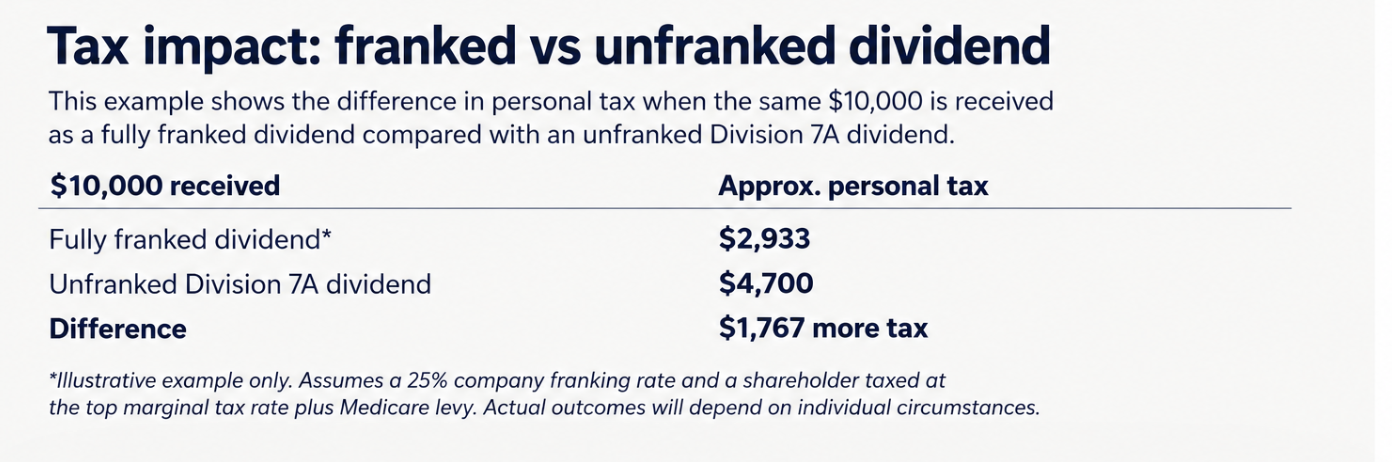
Importantly, having the shortfall treated as a Division 7A dividend does not necessarily make the underlying loan disappear.
The shareholder may still owe the debt to the company while also facing the additional tax liability.
What is a Division 7A deemed dividend?
A deemed dividend is an amount that the tax law treats as a dividend even though the transaction may originally have been recorded as a loan, payment or another benefit.
A Division 7A deemed dividend may arise where, for example:
- a relevant loan is not repaid or put on complying terms by the company’s lodgment day
- the minimum yearly repayment on an existing complying loan is not made
- certain payments are made to a shareholder or their associate
- a private company forgives certain debts.
The amount is generally included in the recipient’s assessable income as an unfranked dividend, subject to the company’s distributable surplus.
What about unpaid present entitlements and bucket companies?
Division 7A can also become relevant where trusts and private companies operate within the same group.
An unpaid present entitlement, or UPE, can arise where a private company beneficiary is entitled to trust income but the amount has not actually been paid to the company.
A private company used in this way is often referred to as a bucket company.
The Division 7A treatment of unpaid present entitlements can be complex and depends on the timing and structure of the arrangement.
If your business structure includes a trust, bucket company or unpaid present entitlements, these should be reviewed as part of your tax planning rather than left to roll forward without consideration.
What should business owners review before 30 June?
Division 7A is much easier to manage before deadlines are missed.
Before 30 June each year, business owners should:
Review shareholder and director loan balances
Check whether company funds have been used for drawings, personal expenses or other private payments.
Check existing loan agreements
Confirm the outstanding balance, remaining loan term and current benchmark interest rate.
Recalculate minimum yearly repayments
Do not assume last year’s repayment amount will still be sufficient.
Confirm repayments have actually been made
Check the required amount has been paid before 30 June.
Review dividends and remuneration
If you regularly borrow from the company to fund personal expenses, consider whether salary, director’s fees or dividends may be more appropriate.
Review trusts and unpaid present entitlements
Where a private company beneficiary or bucket company is involved, check the treatment of unpaid present entitlements and related-party balances.
A note for QBCC licensees
Division 7A loans can create an additional issue for Queensland building and construction businesses subject to the QBCC Minimum Financial Requirements.
Where a director or related entity owes money to the licensee, that loan is not automatically accepted in the QBCC net tangible asset calculation.
For the related-party loan to be included, the related party generally needs to meet the relevant QBCC requirements, including having:
- net tangible assets of at least $0
- a current ratio of at least 1:1
at the same balance sheet date.
If your QBCC financial position relies on loans owed by directors or related entities, the arrangement should be reviewed before financial information is lodged.
How to avoid Division 7A problems
Good Division 7A management starts with keeping accurate records and reviewing company funds that have been provided to shareholders or their associates.
If a private company makes a loan:
- identify it early
- determine whether Division 7A applies
- put any required written agreement in place before the deadline
- use the correct benchmark interest rate
- calculate minimum yearly repayments each year
- keep records of repayments
- review the arrangement as part of annual tax planning.
Do not assume that simply calling an amount a “director loan” means it is compliant.
Get help with Division 7A loans
Division 7A can affect how business owners access money from a private company, how much needs to be repaid and the tax consequences if the rules are not followed.
At Bonerath & Co., we can help review existing director and shareholder loans, calculate minimum yearly repayments, assess loan agreements and consider Division 7A as part of your broader tax planning.
If you have taken money from your company, have an existing Division 7A loan or are unsure whether your arrangements remain compliant, talk to us before the next repayment or tax deadline.
Frequently asked questions about Division 7A loans
What is the Div 7A interest rate for 2026–27?
The Division 7A benchmark interest rate for the 2026–27 income year is 8.77%.
How long do you have to repay a Division 7A loan?
Unsecured loans generally have a maximum term of seven years. Certain loans secured by a registered mortgage over real property can have a maximum term of 25 years.
When does a Division 7A loan agreement need to be in place?
A complying loan agreement generally needs to be in writing before the private company’s lodgment day for the income year in which the loan was made.
What happens if I miss a minimum yearly repayment?
The repayment shortfall may be treated as an unfranked dividend and included in the recipient’s assessable income, subject to the Division 7A rules and the company’s distributable surplus.
Does Division 7A only apply to directors?
No. Division 7A principally applies to benefits provided by private companies to shareholders and their associates.
.png)